
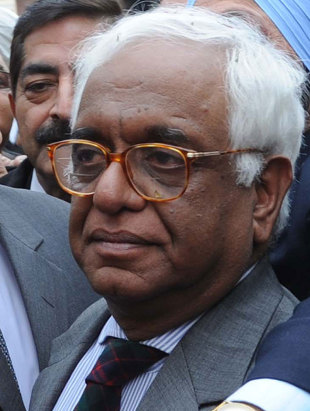
On Tuesday the Indian Supreme Court will confirm whether Justice Mukul Mudgal will once again head a probe to uncover more IPL corruption. There is now a weary acceptance that the BCCI cannot be expected to do so on its own.
 What began essentially as IPL code violations is today stuck in gridlock
due to an entanglement of colliding, conflicting interests and personal
and political agendas. An open-and-shut case of broken rules has turned
into a Rubik's Cube conundrum; except, this cube has eight colours on
its six sides.
What began essentially as IPL code violations is today stuck in gridlock
due to an entanglement of colliding, conflicting interests and personal
and political agendas. An open-and-shut case of broken rules has turned
into a Rubik's Cube conundrum; except, this cube has eight colours on
its six sides.
Yes, the Supreme Court was brought into the debate by parties aiming to
strike at the BCCI's power structures over tackling IPL fraud, but the
court has given the BCCI a chance at every stage to seize control of a
crisis that has spiralled since the May 2013 arrests.
It has steered clear of what outraged defendants call "judicial
overreach". At every stage, the court has been met with resistance,
obfuscation, denial and sidestepping.
The most meaningful outcome of months of legal wrangling and not so
artful dodging was the setting up of the Justice Mudgal IPL probe
committee. It is the first serious inquiry into corruption in Indian
cricket after the CBI investigation into match-fixing "and related
malpractices" in 2000. Despite tight terms of reference and limited
investigative powers, the committee has held a mirror up to the flawed
functioning of the BCCI after the Delhi and Mumbai police blew open the
lid on the spot-fixing scandal.
The Mudgal committee brought to the attention of the Supreme Court
allegations that required a response from the BCCI. Justice Ibrahim
Khalifullah said, "If there has to be a fair and dispassionate enquiry, Mr Srinivasan must step down."
Over the past year, BCCI president N Srinivasan's deeds and words have
given away his motives: to remain entrenched in the BCCI, to delay
action against his IPL team Chennai Super Kings, and to hold on to a
promised position in the ICC. Because, he remains, of course, an
honourable and innocent man who has done nothing wrong.
The Mudgal panel sifted through a steaming pile of IPL corruption and
the formidable self-righteousness of the man at the top of the tree. It
did so methodically without ever veering off legal ground or losing
equanimity, even when it suspected that audio recordings of depositions
were being sent to interested parties outside the room.
The Mudgal panel was commissioned on October 9, 2013, and it submitted
its report to the court on February 10, 2014. Justice Mudgal, Additional
Solicitor General L Nageshwar Rao, and Nilay Dutta brought a combined
legal experience of around 100 years to the panel. They were assisted by
three juniors, Vidushpat Singhania, who was secretary of the
commission, Gautam Bharadwaj and Abantee Dutta.
The commission first asked "persons possessing information" that was
relevant to contact them on email, assuring confidentiality. Through
BCCI emails, it invited individuals to appear before them with due
notice given of time and place. The exact number of depositions before
the committee is not known: 52 people are named in the report, with a
few, on request, remaining unnamed and therefore unaccounted for. The
commission was assisted by a couple of BCCI officials who were to look
after logistics and then stand aside.
| It should not be a surprise to hear that recordings were being passed to those outside the committee. This is the BCCI - it contains businessmen, lawyers, politicians; all experts in seizing, controlling and protecting power. Nicking tapes is small stuff | |||
Hearings took place in hotel business centres in five cities - Delhi, Mumbai, Chennai, Kolkata and Bangalore.
Each person called in was told, first up, that it was to be an
interaction, a conversation to gather strands of information, and by no
means an interrogation. The conversation was being recorded to ensure
the minutes of the meeting were accurate; it was not to be evidence in
court. Should the recordings make the individual uncomfortable, they
could be stopped at any time.
Mudgal, the oldest of the three, avuncular, relaxed moved the discussion
along as if they were discussing the weather. Nilay Dutta was social,
chatty, making jokes, smiling even while asking for more precise detail.
Rao, at the far end end of the conference table from the other two,
listented silently until he put in an incisive query - of the kind whose
answer would make you trip over any falsehood uttered along the way. In
tone and tenor it was a rambling conversation, but it was hard to
ignore the glimmering edge of legal expertise in the room.
Journalist Pradeep Magazine has appeared before this commission and
another related to illegal betting and fixing in Indian cricket. In
1997, the BCCI appointed a one-man commission under a retired chief
justice of India, YV Chandrachud, to respond to an Outlook magazine cover story about match-fixing and a piece by Magazine in the Pioneer
newspaper relating to India's 1997 tour of the West Indies on which
Magazine had a bookie make him an offer of money to approach Indian
players to fix matches.
The Chandrachud commission asked Magazine nothing about that experience
or what he knew or had heard about illegal betting in and around the
Indian cricket team. Players who appeared before the judge were asked
for autographs. One said, "It did not feel serious. You weren't asked
one searching question." Three years later, Hansie Cronje happened.
Magazine says today that he was struck by the difference between the two
commissions. The Mudgal panel asked for all the information and leads
he had to offer and listened to him, rather than talking about what a
great game cricket was.
The Mudgal Commission interviewed players, officials, policemen,
journalists, and a range of others, who provided truths, untruths,
hidden truths, nuggets of information, idle gossip, propaganda, agendas.
They were told tales, some tall, some true, presented with police tapes
and reports. They probably ran into walls of silence, far from direct
answers, and many claims of "don't know, can't say". Mudgal told
ESPNcricinfo, "I've been a judge for about 15 years, I have seen all
facets of human behaviour - murder, etc. So was I surprised? No."
It should not be a surprise to hear that deposition recordings were
being passed to those outside the committee. This is the BCCI - it
contains businessmen, lawyers, politicians; all experts in seizing,
controlling and protecting power. Nicking tapes is small stuff.
The BCCI's latest legal tack is an attempt to disprove the Mudgal
commission's findings, calling for audio and transcripts, and setting in
motion a whisper campaign about the panel members. It is however, yet
to answer a simple question: apart from banning three cricketers,
why have neither Chennai Super Kings or Rajasthan Royals been punished
for their links to illegal betting? What we get instead is
self-proclaimed honour, innocence, and claims of no wrong-doing.
In contrast to such dithering, the Mudgal Commission finished with its
job in four months. It didn't miss a deadline, or bend or break any
rules. Should the court order that the commission continue the
investigation, the panel could do with both assistance and teeth:
professional investigators, judicial powers and constant monitoring by
the Supreme Court.
The panel has proved what was already suspected: other than the general
nuts and bolts of the game and commercial rights, when dealing with the
serious stuff gnawing away underneath, Indian cricket cannot and will
not regulate itself.
Post a Comment